

No engineer should decide from evidence that’s months out of date.
That’s the mission, stated plainly. Turning raw inspection evidence into decisions an engineer can defend applies equally to gas pipelines and to refinery static equipment - fired heaters, vessels, tanks, elevated piping - not to one first and the other later.
Critical infrastructure leaks - energy, integrity, and attention - in ways that stay invisible until something breaks. LeakSonic exists to make that loss visible early enough to act on, across gas pipelines and refinery static equipment alike.
Sentrix pairs AI-driven decision-intelligence software with the drone hardware we design, build, and test ourselves to validate, compare, prioritise, and report inspection findings across oil and gas infrastructure - gas pipeline and City Gas Distribution networks, refineries, terminals, and offshore platforms - turning raw inspection evidence into standardised, decision-ready engineering intelligence inside the workflows operators already use.
Everything we build is measured against one standard - does it help an integrity team make a faster, better-evidenced decision, with less manual effort, than the workflow it replaces?
Actively building, and looking for the right partners to build it with.
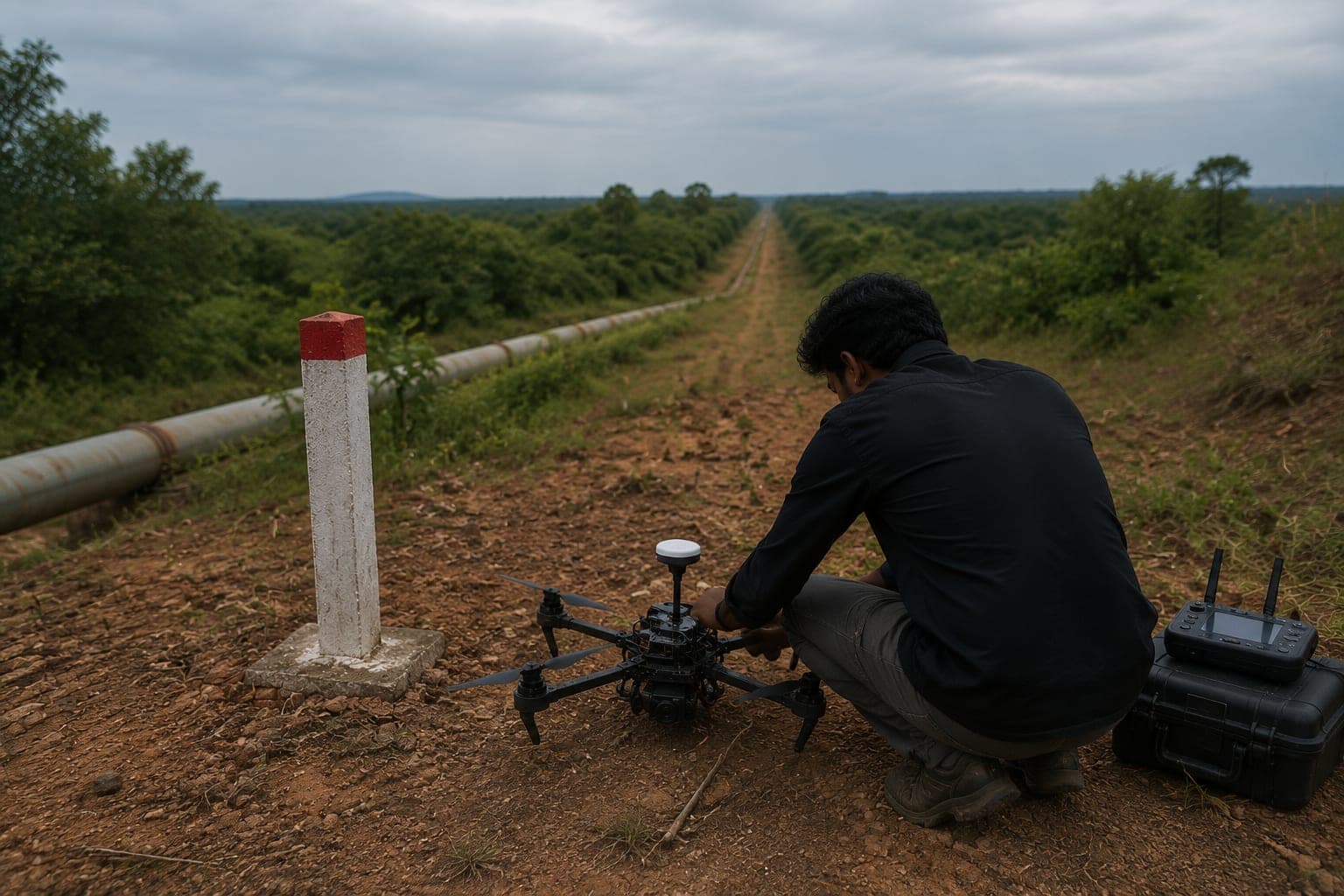
Sentrix is in active product development, and a lot is happening at once: we are refining the platform, testing the claims published on our approach page with practising engineers, and meeting directly with PSU pipeline operators - we have presented Sentrix to Indian Oil Corporation’s Southern Regional Pipeline engineering leadership and visited an active GAIL (India) Limited construction site (see our field visit), and are working from there toward pilots.
We’re actively seeking further pilot, research, and program partners who want to work through this together: operators looking to reduce inspection cost and catch integrity risk earlier, and researchers who want real operational data behind their work. If that’s you, we’d like to hear from you.
Alongside Sentrix, we’re also in early exploration on Corvex, a continuous ground-based cathodic-protection monitoring concept - a complementary line of work, not a separate product launch, and not yet a priority next to getting Sentrix right.
The underlying AI and decision-intelligence software is deliberately built to generalise beyond oil and gas. We see long-term potential in adjacent domains - defence and national-security infrastructure inspection, broader industrial infrastructure intelligence, and coordinated multi-drone (swarm) operation among them - and it’s a direction we may pursue as the platform and our funding position mature. That is early, exploratory thinking today, not a current engagement or a near-term priority next to getting pipeline and refinery inspection right.

Kiruthik M R - built by an engineer who went to the field first
The founding conviction is simple and slightly unfashionable: the hard part of asset integrity - on a pipeline or on a refinery floor - isn’t collecting more data, it’s deciding what the data means. That conviction came from the field - from standing on a live construction site and seeing where the real bottlenecks are - not from a slide deck, and it shapes every technical choice the company makes.
The founder’s view is that drone hardware on its own, at today’s state of the art, is only moderately scalable - useful, but not yet the leverage point. AI is where the real long-term potential sits: as sensing, autonomy, and onboard computing keep improving year over year, the ceiling on what an AI-guided drone can actually do keeps rising with it. That’s the bet behind building our own hardware rather than treating it as someone else’s problem - it keeps the AI honest, and keeps us close to a field that is still moving quickly.
LeakSonic’s founding team has a track record in applied engineering competitions, including a national win at India’s Smart India Hackathon 2025 - one early signal among several, not the headline. LeakSonic Private Limited is a deep-tech startup funded by the MeitY Startup Hub and MSME (Udyam) registered, actively engaging with PSU pipeline operators while Sentrix is in active product development, and our core methodology is proprietary, with a patent application filed.
The case for the company, in four parts
Why this problem
Energy loss and integrity risk on critical infrastructure - gas pipelines and refinery static equipment alike - are largely invisible until something fails: expensive, hazardous, and climate-damaging when it does. The tools to see it exist but sit disconnected from the decisions that matter. That gap is a real, unglamorous, high-consequence engineering problem worth a company.
Why this company
AI is the core of what we build - the scalable engine that makes evidence comparable, findings defensible, and output fit existing workflows. We are not purely a software company, though: we design, build, and test our own drone hardware and ground-control tooling in-house, at a deliberately focused scale, because an AI model is only as good as the real flight data it learns from. Software and hardware together, with AI as the primary source of long-term value - a narrower, harder, more defensible focus than competing on flight logistics alone.
Why now
Gas networks and refinery capacity are expanding worldwide faster than inspection can scale, and methane is shifting from an estimated to a measured quantity under frameworks like OGMP 2.0. Operators need to make more inspection decisions, faster, from evidence they can stand behind - and the manual workflow that used to be good enough no longer is. The timing is not incidental; it’s the thesis.
Where we’re headed
Pipeline corridors and refinery static equipment - fired heaters, vessels, tanks, elevated piping - carry the same evidence-to-decision problem in different settings, and we’re building for both as genuine, current application areas of the same platform. The AI itself is being built to reason about inspection evidence generally, not just drone imagery - our own drone hardware is the primary source today, with the architecture designed to take in more of it over time. Built in India, with the deliberate intent to expand into a global market as the platform and the evidence behind it mature - one validated claim at a time, not a launch announcement.
The case in brief
A short, honest version of the pitch - no invented traction, no projected numbers we haven't earned. For the full conversation, reach us directly.
Market
Gas transmission and distribution networks, and refinery and industrial static equipment, are both expanding and ageing worldwide faster than inspection capacity can scale, and methane reporting is shifting from estimated to measured under frameworks like OGMP 2.0 - a structural, multi-decade demand curve, not a one-time opportunity.
Why defensible
Flight hardware alone is increasingly commoditised and, by itself, only moderately scalable; the proprietary AI and decision layer that turns raw inspection evidence into comparable, defensible findings is what actually scales - and it is what we build the hardware around, not the other way round, with a patent application filed on our core methodology. That is a data, algorithms, and domain-trust problem, not a flight-logistics one - harder to replicate and harder to dislodge once an operator’s workflow depends on it.
Team
LeakSonic Private Limited, a deep-tech startup funded by the MeitY Startup Hub and MSME (Udyam) registered, with a national Smart India Hackathon 2025 win, actively engaging with PSU pipeline operators - and a founding conviction grounded in field time on an active pipeline construction site, not a slide deck.
For grant programs, incubators, and government reviewers
If you evaluate applications for programs like NIDHI-PRAYAS, iDEX, GAIL Pankh, IndianOil Ankur, MSME innovative schemes, or a deep-tech accelerator, the honest version of our stage and traction is exactly what you’ll get here and on our approach page - LeakSonic Private Limited, a deep-tech startup funded by the MeitY Startup Hub, building a specific, named engineering capability, not a generic AI pitch. We would rather a reviewer find our stage clearly stated than have to ask.
Stage, honestly
Actively developing and validating Sentrix with practising engineers - see exactly what we’re testing and how on our approach page. We’d rather show you the real stage than round it up.
Moving pipeline integrity from periodic and reactive to continuous and evidence-based.
The industry is changing on three fronts at once: from inspection you do on a calendar to inspection informed by what’s actually happening, from methane you estimate to methane you measure, and from raw data an engineer wades through to decisions they can defend. Sentrix is built for that shift - and the shift itself is why our work touches goals far larger than any single pipeline.
Aligned with the UN Sustainable Development Goals
Methane is one of the most potent near-term greenhouse gases. Helping operators find and fix leaks faster - and supporting the shift to measurement-based reporting under frameworks like OGMP 2.0 - targets one of the highest-leverage climate levers available this decade.
Resilient energy infrastructure depends on being inspected and maintained well. We build deep-tech that helps pipelines last longer and fail less - the definition of upgrading infrastructure with innovation.
Natural gas is a transition fuel, and every leak is energy lost between source and consumer. Improving the integrity and efficiency of gas delivery keeps supply reliable and less wasteful through the energy transition.
A gas leak is lost product as well as an emission. Prioritising inspection where it matters most reduces the waste of a finite resource and the environmental cost of losing it to the atmosphere.
Much gas infrastructure - especially city gas distribution - runs directly beneath and beside where people live and work. Better, faster integrity monitoring reduces the risk of incidents in populated areas.
Drone-led inspection removes people from genuinely dangerous work - at height, in confined spaces, and near live hazards. Fewer people exposed to inspection risk is a direct, tangible safety outcome.
We frame these as goals our work contributes toward and is aligned with - not achievements we claim. Each reflects a specific, defensible connection between pipeline integrity intelligence and a global objective.
Let's reduce inspection cost and speed up your decisions - together.
We’re a small, focused team actively building Sentrix and looking for the right partners to build it with - operators, programs, researchers, and investors. Tell us who you are and we’ll route the conversation accordingly.